
Cite this Essay
MLA:
Mukherjee, Durba. “Ved Mehta: A Critical Biography.” Indian Writing In English Online, 13 July 2025, https://indianwritinginenglish.uohyd.ac.in/ved-mehta-a-critical-biography-durba-mukherjee/.
Chicago:
Mukherjee, Durba. “Ved Mehta: A Critical Biography.” Indian Writing In English Online. July 13, 2025. https://indianwritinginenglish.uohyd.ac.in/ved-mehta-a-critical-biography-durba-mukherjee/.
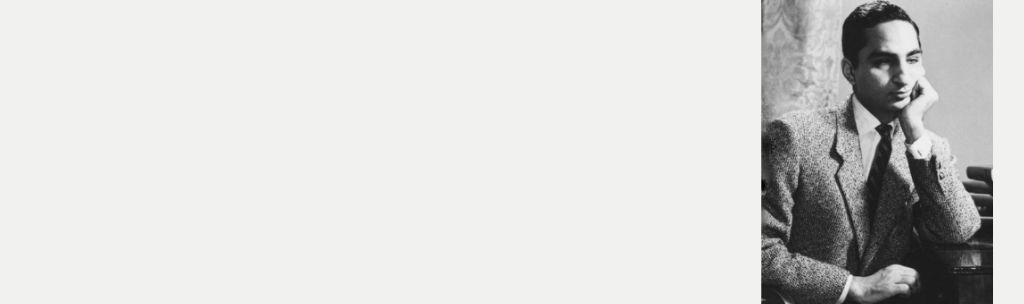
Ved Parkash Mehta (21 March, 1934 – 9 January, 2021) was born in Lahore in the erstwhile undivided India in a middle-class, Hindu family. He was an author and a journalist based in Manhattan, New York, and contributed to the New Yorker for around three decades. Mehta succumbed to Parkinson’s at the age of eighty-six. Blinded by meningitis when he was only four, Mehta’s prolific literary career is a remarkable achievement, not merely for its exhaustive volume, but also for the detailed graphic accounts that frequently feature in his texts. With limited access to education since amenities for Braille learning were almost non-existent in India during Mehta’s upbringing, his literary career is an example of grit and a unique self-fashioning. Not only was it a fact, during his milieu, that visually impaired persons in India found a professional career nearly impossible and the only decent alternative was to become a music teacher, but also most of them lived a life of poverty and dependency. In The Ledge between the Streams, Mehta reminisces, “‘I knew what I didn’t want to be—a beggar, shopkeeper, or street hawker” (80). He adds, “singing may be about the only profession that can provide a respectable livelihood for a blind person” (80). But he was reluctant to pursue it professionally. He was sent to Dadar School for the Blind, Mumbai (founded in 1900), a primary school that is located some fourteen hundred kilometres away from his family in Lahore. At the age of five, Mehta experienced an early dissociation from his familial home to which he returned after a preliminary training, but his stay was curtailed by the violence of partition.
With Lahore declared as part of the Islamic state of Pakistan in 1947, most surviving members of Mehta’s family found themselves uprooted as refugees in India. [1] Once in India, Mehta’s immediate family moved to Shimla, where his father was posted as the director of the Public Health Department, East Punjab. During their stay, Mehta often visited the refugee camps around Ambala along with his father, while the latter was on his duty-vigils. It was on these visits with the senior Mehta that the author found himself overwhelmed by the state of homelessness and poverty of the refugees. This experience propelled him further to seek formal education because he believed it to be the only antidote to unemployment and poverty. At around the same time, he moved to Dehradun’s St. Dunstan’s for basic Braille training. Braille copies of English texts in India were rare but it was during his stay at Dunstan’s for a period of eight months that Mehta read a few Braille English books and magazines available in the library and grasped rudimentary English from his interactions with the Scottish gentleman who ran the school. After repeated failed attempts to enrol himself at American institutes due to the lack of his formal schooling and limited knowledge of English, a fifteen- year-old Mehta finally found acceptance at Arkansas School for the Blind and he moved to America. His training at Arkansas, was followed by a bachelor’s degree at Pomona College. Mehta went to Oxford for his second bachelor’s degree in history, and later returned to Harvard for his master’s degree. Since then, Mehta had been mostly living in the west, finally settling down in Manhattan, New York, where he breathed his last.
Repeated displacements, partition experiences and trauma of communal riots had strong and lasting impressions on his mind. His return to India after his education at Oxford in late 1959 was preceded by a phase of self-introspection in terms of his socio-cultural and national belonging which he records in his autobiographical work, Face to Face. If Face to Face (1957) can be considered Mehta’s earliest attempt at engaging with his identity vis-à- vis his displacements, then his first travel memoir, Walking the Indian Streets (1960, originally published in parts in the New Yorker), foregrounds his hopes of nostalgically restoring an Indian homeland through his return and re-engagement with the physical space of India. Indeed, the repeated dislocations, his sense of cultural belongingness to India, hinged on the Nehruvian appeal that underlined the Indian middle-class milieu created a deep desire of returning to and contributing towards building a modern India. As he travelled across the subcontinent Mehta realised that the “reality [of India] was too much with [him]” (Face to Face 119), despite his initial insistence. The desire of restoring his homeland being thwarted on his physical engagement with the country, which is the problem that informs his literature of return on India (for details on Mehta’s literature of return, see Durba Mukherjee and Sayan Chattopadhyay), Mehta goes onto engage deeper with his understanding of self within his socio-historical context. As a consequence, Mehta turns repeatedly to the autobiographical genre as a literary form, and, through the course of his life, writes a formidable compendium, titled, the Continents of Exile. The collection strings together a vast body of writings about the authorial self. The collection begins with the autobiographical texts, Daddyji (1972) and its accompanying text, Mamaji (1979) that chalks up the familial trajectories of his father, Amolak Ram Mehta, and his mother, Shanti devi Mehta nee Mehra, and how they strongly shaped his own identity as a modern Indian through his early days. While the first is the story of his father and his Hindu family’s migration from a rural India to a modern, urban, colonial India and his initiation into an Indian middle-class identity, the second, as Mehta describes, is the story of his mother, who was born in an urban, colonial India and her side of the Hindu family that sought to “consolidate its place” (1979, i) within the changes brought about by the colonial history of the country.
Subsequently, Mehta wrote Vedi (1982) as an attempt to re-visit and make sense of his atypical days of schooling and Braille training at Dadar, between February 1939 and May 1943, among children, who were either waifs or belonged to economically marginalised families. The children all spoke the regional language, Marathi, which the Punjabi-born Mehta picked up soon, indicating his capacity to adapt to an unfamiliar space that is further revealed in the next memoir. These three texts are followed by a revision of Mehta’s debut-memoir, Face to Face, and is titled, The Ledge Between the Streams (1984). The text re-drafts his experience of partition by revisiting his notion of the Indian sub-continent as his familial home and his contrasting experience of finding his identity through the Western education system and the institutes of education in the West. In his next book, Sound-Shadows of the New World (1986), Mehta reveals that it is in America that he finds a sense of social freedom for the first time as he learns to navigate the streets by himself, unlike in his childhood in India, where he would feel uncomfortably conspicuous due to his visual impairment. Torn between his initial longing to return to India, which he still identified as his homeland, and his new-found sense of belonging to America, the book depicts the guilts and yearnings that shaped his adolescence as he moved to California from Arkansas. The Stolen Light (1989), that was published next, takes his readers through his intimate adolescent life, heart-breaks, and his search for a sense of security in the spaces that homed him till date. Up at Oxford (1993) is a curious description of Mehta living his childhood dream of being at Oxford and his encounters with his fellow Oxonians, W.H. Auden, Peter Levi, Allen Ginsberg, Isaiah Berlin, E.M. Forster, Dom Moraes, etc. in the 1950s as a student at Balliol College.
Unlike his previous books that grapple with his evolving sense of identity with regard to the societies that he encounters, Remembering Mr. Shawn’s New Yorker: The Invisible Art of Editing (1998) is a book that commemorates Mr. William Shawn, the editor-in-chief of the New Yorker from 1952 to 1987 through his personal interactions, letters, and interviews, and portrays him as a major influence on Mehta’s career as a journalist. All for Love (2001) and Dark Harbour: Building House and Home on an Enchanted Island (2003) are two very intimate accounts of finding his emotional bearing in the States through a period of quest for companionship and a home-space respectively. The Red Letters: My Father’s Enchanted Period (2004) is another intimate disclosure of his father’s clandestine affair and through the process of writing an effort on his part to understand more closely the senior Mehta. [2]
Quite early in his career, Mehta also wrote Fly and the Fly-Bottle: Encounters with British Intellectuals (1963) based on his interactions with some of the prominent British historians and philosophers. In the course of the book, Mehta hosts a light-hearted, very British banter regarding scholarly ideas, rigorously discussed among the British intellectuals of his time. He takes up the identity of a critical spectator and through a presentation of his lively encounters with British intellectuals, like the Oxford philosophers, who are often expostulated as “linguistic philosophers” (1963, 5), or historians belonging to the coterie of the “New Cambridge Modern History” (248), who are often accused of being “dull and static” (248), argue for the case of a compassionate approach towards their individual frailties through his personal interactions with them. Mehta also wrote The New Theologian (1966), where he dealt with Right Reverend John Robinson’s theological ideas that created a stir in British society. [3]
Commending his work on India, after the publication of The Ledge between the Streams, Robin Lewis, a professor of Indian literature at Columbia University, stated in an interview that was published in the Times, “[in] a very quiet way, Ved Mehta is breaking the Western stereotypes and getting America to look at India as something other than a grandiose stage setting” (qtd. in Smith). Lewis added, “[he’s] taking the raw material of his personal experience and combining it with some of the pains, crises and historical dislocations that India has gone through” (qtd. in Smith). Apparently, Ledge between the Streams might seem like a cursory revision of Mehta’s 1959-memoir, Face to Face, being published at a later juncture of his writing career as an autobiographer. Yet, read in the light of Mehta’s re-engagement with the physical space of the Indian subcontinent on his returns and the near twenty-five years of self-introspection that separated the two books, one finds some interesting revisions that characterise the latter text. In Face to Face, Mehta writes about “tragedy, division, and change” (x; foreword) with regard to the Indian partition that he witnessed as a child at Lahore and Rawalpindi under the sub-section “India and Home.”
However, with subsequent returns to the subcontinent years after the traumatic experience, Mehta in the later text abandons the subtitle, “India and Home” and resorts to shorter chapters individually titled that signified distinct experiences that are outlined in his memory and shaped his identity, like “The Two Lahores,” “January, 1947,” and “February.” The switch in nomenclature in the latter text marks his transformation, as Mehta no longer seeks to restore his Indian home in his writing, like he sought to do in the earlier memoir, but merely reflects on the loss and change that he experienced. In turn, he also steps closer to the understanding that his Indian home is merely a feeble shadow of his familial home of Lahore, or the homeland that he sought to identify with. Besides the trauma of partition, Mehta reveals his sense of acute proprioceptive crisis while in India which is revealed in a statement, quoted from a personal conversation with the author by Maureen Dowd in his article for The New York Times Magazine, “[the] basic wound of growing up in the India of my childhood was that blindness was considered sexually crippling.” Also, with the critical scholarship in India framed by nationalistic consciousness in the decades after Indian independence, literatures in other Indian languages were prioritised over English (for details on the debate about the use of English in India, see Sadana 16 – 18; Jussawalla), and often within Indian writing in English, like most early sections of postcolonial writings, the critical approach was to marginalise elitist (read Anglicised here) authorial voices (for details, see Lazarus xiii) writing about the postcolonial (read Indian) society. In turn, though Mehta’s texts about India found a significant readership in the West, primarily in America, his voice as a critic of modern India seems to be explored only marginally. It is thus understandable that Mehta not only embraced America, the country that honoured him with the MacArthur Fellowship in 1982, for the acceptance that he found in the country as an author, but also, as he puts it, “America […] did not hold blind men at arm’s length” (Face to Face 183).
His sense of belongingness, therefore, to America and his coming to terms with the facts that neither can he restore his imagined homeland in India, nor will he find his professional grounding in the subcontinent, in turn, resulted in his lengthy and often critical discourse about India, writing from his metropolitan First-World perspective, through which he found a sense of agency that he lacked in his earlier days. Further, even though dislocations underlined Mehta’s search for a sense of belonging, and in turn, interrogate his self-identity, he was largely influenced by his colonial middle-class background. Consequently, Mehta’s life and literary trajectory sustain two significant characteristics of his immediate literary predecessors within Indian literature in English. First, his writing is primarily concerned with his self-fashioning as a middle-class, westernised gentleman which explains Mehta’s choice of the autobiographical form for most of his writings. [4] Second, his returns to India and the period of his stay in the subcontinent is inextricably woven into his exploration of India, and subsequently, his own Indian identity through his middle-class sensibilities. [5] Once he was able to resolve the crisis that he was faced with on the loss of his imagined Indian homeland and could accept his diasporic identity in that that despite making New York his home he could find his grounding in India through his writing, Mehta more readily gravitated towards the genre of literary journalism about India.
In turn, his Portrait of India (1970), Mahatma Gandhi and his Apostles (1977), A Family Affair: India under Three Prime Ministers (1982), and Rajiv Gandhi and Rama’s Kingdom (1994) are not only some of the early attempts at literary journalism within the field of Indian English literature, but can also be considered the author’s attempts at politically portraying the heteroglossia that is India. The first book on Gandhi attempts to understand one of the most popular mass-leaders of 20th-century India through the eyes of his disciples. By espousing Gandhi’s unwavering task of alleviating poverty, caste-system, and marginalisation through non-violence, the book draws a closer image of the figure through the eyes of his closest disciples. Subsequently, as Mehta suggests, though none of his disciples conceives of Gandhi as a hypocrite, it is ironic that the ideals that he upheld could mostly be sustained by individuals trained within the colonial discourses of humanism and rationalism. Interestingly, Mehta critiques Gandhi as a paradox as much as he found India as a country to be in the first place (Walking the Indian Streets 12). Likewise, Mehta’s next book, A Family Affair, is simultaneously a critique of the India under Indira Gandhi’s rule and that of the Janata coalition in Indian politics in portraying the widening gap between a secular-minded, Western-style educated middle-class and an atavistic, populist, caste-prejudiced section of the Indian population. Further, from the days of his initial dejection of and a feeble suspicion of Nehruvian socialism and its failure in eradicating poverty, as can be observed in his earlier texts, the last two biographical works are more directly critical of the economic system as he suggests that the government has instead led to a steady rise of sycophants and social-climbers, who have systematically disrupted a secular and uniform development of the country that was envisaged during the days of its emergence as an independent nation. Yet, apart from his laconic observations, Mehta fashions these four texts as representations of the late-twentieth-century India in the form of a collage of his interactions with people and the conversations that he overheard.
In fact, by the time Mehta engages with the political, socio-cultural, religious aspects of India in his first piece of literary journalism in the early 1970s, he had already established himself as a journalist, having worked for the New Yorker (which he joined in 1961) for around a decade. It is interesting to note that Mehta had once aspired an academic career. However, as he writes in the introductory essay of his book, The Ved Mehta Reader (1998), that it was while he was at Oxford that Mehta first developed a discerning eye for individual voice and writing-style by reading classical authors but, more importantly, as he writes, patiently writing and revising, persistently focusing on the “economy of thought and language” (xii). With patience and practice, Mehta built his style of prose-writing that read both eloquent, yet, practical and ironically pictured people and places with careful details, allowing him to live an authorial persona that was boldly visual. Perhaps, the world that he was dealing with in his writings vividly remained etched in his imagination, especially when considered that Mehta was visually capable till he was a boy of four, providing him with the zeal to engage with autobiographical literature at the early stage of his literary career. Having successfully produced some of his memoirs, it is understandable that Mehta employed his professional expertise to explore his country of origin when he was not employing the form of memoirs. Mehta’s choice of writing memoirs offered him a space to engage with his evolving self-fashioning as an author, whose identity was as much shaped by his affiliations to India, as it was informed by his association with America and England. In contrast, Mehta’s choice of the genre of literary journalism allowed him to parallelly project his association with the kind of cosmopolitanism that allowed him to be a metropolitan observer, who is writing about his country of origin, India. It is thus that in a later interview Mehta says, and Dowd quotes, “I don’t belong to any single tradition. I am an amalgam of five cultures – Indian, British, American, blind and The New Yorker.” Mehta’s identification of himself in such terms, late in his life, was an outcome of his acceptance of the various aspects that he earlier perceived as at odds with each other, just like his anxiety of returning to the physical space of India and settling down in the country was looked upon as a disjunction with his Indian identity. Contrastingly, through his writings and over the course of time, Mehta realised that he can as well shape his Indian identity through his engagement with the country in his writings, while being settled in any part of the world. Likewise, he sought to make up for his visual impairment through the visual images in his texts. As an author, Mehta’s multiculturalism is more an assertion of the facets of his identity that he consciously built in his writings as he evolved through his experiences rather than a blind acceptance of the experiences that shaped him.
Apart from a significant body of autobiographical and journalistic writings about India, Mehta also wrote several journalistic essays on philosophical and intellectual topics that are published in the collection, A Ved Mehta Reader: the Craft of the Essay (1998). A postscript by the New Yorker, “Remembering the Longtime New Yorker Writer Ved Mehta,” states that the essay, “A Battle Against the Bewitchment of our Intelligence” (originally published in 1961) that dabbles with the intellectual debates of the 1950s British society is one of the most intellectually stimulating and, simultaneously, compassionate in tone. Another book by Mehta, John is Easy to Please (1971), is an engagement with Chomsky’s transformational grammar. Besides, Mehta authored Photographs of Chachaji (1980) that was adapted into a documentary and he is also the author of a short novel titled, Delinquent Chacha (1991) with an anglophile protagonist born in colonial India, who is nostalgic for colonial rule in independent India. Mehta’s Three Stories of the Raj (1986) is a collection of short stories and deals with the socio-political situation of India under the colonial regime. Stories such as “Four Hundred and Twenty” highlight discrepancies between British law and the disparity when it comes to practicing the same in the colonies. The collection also embodies nostalgic portrayals of changing value systems, from traditional Indian societies to postcolonial, modern India, as in the stories, “The Music Master” and “Sunset”. The stories are first-person reflections of a sensitive and humane observer, elegantly sewing his memories together. Mehta also wrote a terse, journalistic enquiry of India during Indira Gandhi’s regime, titled The New India (1978), expressing a sense of disillusionment with the new India that he saw take shape since the two and a half decades of its independence. Despite his personal transformations as an author, from being a hopeful Indian citizen to a disillusioned Indian expatriate, and a vast spectrum of subjects that his writings deal with, what remains constant throughout Mehta’s writing career, is the ability to paint vivid visual details. Besides contesting his physical sense of lack that informed his childhood and adolescence in India in his adoption of a bold visual persona, it can be added that Mehta consciously harboured a keen, almost boastful, ability to portray his surroundings, exemplifying which, his Portrait of India opens with:
I present myself at nine o’clock at the Imperial Hotel, an embarkation point for city tours […] I take a seat in the front of the first bus, near the guide, who is an elderly Sikh with a long beard. He is clad in dingy beige turban, a patched beige tweed coat, loose gray flannels, and brown sandals, with a white drip-dry shirt, which is the only immaculate part of his dress; the shirt is open at the neck, showing a bit of maroon neckcloth. (6)
Another interesting aspect of Mehta’s writing is the fact that though he talks in detail about his blindness and his adaptations in getting around and keeping pace with the world in Face to Face, he chooses not to refer to it at all in Walking the Indian Streets, except for its preface. Speaking about Mr. Shawn’s influence on Mehta, Hemachandran Karah notes, “Mr. Shawn counselled the writer not to dwell on his blindness unless it is the theme of his work. […] For Mr. Shawn, blindness seemed like a narrative theme rather than a mere sensory deprivation. […] As a true Shishya to Mr. Shawn, Mehta dwells on the theme of his blindness only when he writes specifically about it” (“Blindness, Lockean Empiricism, and The Continent of Britain” 263). Also, in wilfully underplaying his blindness in his body of writing, Mehta recreates for himself an independent authorial identity, that is as much sensorily plugged-in to the surrounding, as imaginatively invested in the space/subject that he chooses to portray. [6]
Endnotes
- The traumatic memory of partition that complicated Mehta’s association with India was further aggravated by the crisis of secularism in modern India and he engaged with the issue of fundamentalism in India in his analytical work, “The Mosque and the Temple: The Rise of Fundamentalism” (1993).
- The article, “Mehta, Ved 1934-” in the Cengage website, https:// encyclopedia.com/arts/culture-magazines/mehta-ved-1934, very comprehensively summarises the contents of the eleven texts in Continents of Exile besides talking about Mehta’s writing career. It also provides a comprehensive list of all the awards and fellowships that Ved Mehta won during his lifetime.
- It is to be noted that most of Mehta’s texts were originally published in parts in The New Yorker.
- Most colonial Indian middle-class returnees after a period of dislocation in the west, have engaged with the genre of life-writing. Thus, Indian writing in English has a vast repertoire of life writings from the early twentieth century onwards by writers like Surendra Nath Banerjea, Cornelia Sorabji, Jawaharlal Nehru, and Santha Rama Rau.
- Mehta’s trajectory of self-fashioning as is explored in his life writing, Walking the Indian Streets, when read alongside Dom Moraes’s Gone Away (1960) who was his peer at college in Oxford and a fellow traveller across India in 1959, provide two very different engagements with the subject of returning to and self-fashioning vis-à-vis one’s country of origin.
- Two unique views on the way Mehta negotiates with his visual challenge are explored by Hemachandran Karah (2012; 2018) and John M. Slatin (1986).
Primary Sources
Mehta, Ved. All for Love. Thunder’s Mouth Press, 2001.
—. Daddyji. Farrar, Straus, and Giroux, 1972.
—. Dark Harbor: Building House and Home on an Enchanted Island, Thunder’s Mouth Press, 2003.
—. Delinquent Chacha, Harper, 1967.
—. Face to Face: An Autobiography. Atlantic-Little, Brown, 1957.
—. A Family Affair: India under Three Prime Ministers. Oxford UP, 1982.
—. Fly and the Fly-Bottle: Encounters with British Intellectuals.1963. 2nd ed., Columbia UP, 1983.
—. John Is Easy to Please: Encounters with the Written and the Spoken Word, Farrar, Straus, and Giroux, 1971.
—. The Ledge between the Streams. W.W. Norton, 1984.
—. Mahatma Gandhi and His Apostles. 1977. 2nd ed., Yale UP, 1993.
—. Mamaji. Oxford UP, 1979.
—. The New India, Viking, 1978.
—. The New Theologian, Harper, 1965.
—. The Photographs of Chachaji: The Making of a Documentary Film. Oxford UP, 1980.
—. Portrait of India. 1970. Revised ed., Yale UP, 1993.
—. The Red Letters, Thunder’s Mouth Press, 2004.
—. Rajiv Gandhi and Rama’s Kingdom. Yale UP, 1994.
—. Remembering Mr. Shawn’s New Yorker: The Invisible Art of Editing. Overlook Press, 1998.
—. Sound-Shadows of the New World, W.W. Norton, 1986.
—. The Stolen Light, W.W. Norton, 1989.
—. Three Stories of the Raj, Scholar Press, 1986.
—. Up at Oxford, W.W. Norton, 1993.
—. Vedi. Oxford UP, 1982.
—. A Ved Mehta Reader: The Craft of the Essay. Yale UP, 1998.
—. Walking the Indian Streets. 1960. revised ed., Weidenfeld and Nicolson, 1971.
Secondary Sources
Dowd, Maureen. “A Writing Odyssey through India: Past and Present.” New York Times, June 10 1984, https://www.nytimes.com/1984/06/10/magazine/a-writing-odyssey-through-india-past-and-present.html. Accessed 30 May 2023.
Encyclopedia.com. “Mehta, Ved 1934-.” Cengage. https://www.encyclopedia.com/arts/culture-magazines/mehta-ved-1934. Accessed 13 June 2023.
Karah, Hemachandran. “Blindness, Lockean Empiricism, and The Continent of Britain: An Examination of the Identities of Mr. Spectator and Theseus in the Writings of Ved Mehta.” Journal of Literary and Cultural Disability Studies, vol 6, no. 3, 2012, pp. 259–274.
Karah, Hemachandran. “Blind Culture and Cosmologies: Notes from Ved Mehta’s Continent of India.” Disability in South Asia, edited by Anita Ghai, Sage, 2018, pp. 215–227.
Lazarus, Neil. “Introducing Postcolonial Studies.” The Cambridge Companion to Postcolonial Literary Studies, edited by Neil Lazarus, Cambridge UP, 2004, pp. 1 – 16.
Mehta, Ved. Fly and the Fly-Bottle: Encounters with British Intellectuals.1963. 2nd ed., Columbia UP, 1983.
Mukherjee, Durba and Sayan Chattopadhyay. “‘Walking the Indian Streets’: Analyzing Ved Mehta’s Literature of Return,” Life Writing, vol 19, no. 3, 2022, pp. 423 – 440.
Postscript. “Remembering the Longtime New Yorker Writer Ved Mehta.” The New Yorker, 10 Jan. 2021, https://www.newyorker.com/culture/postscript/ved-mehta-1934-2021. Accessed 13 June 2023.
Sadana, Rashmi. English Heart, Hindi Heartland: The Political Life of Literature in India. U of California P, 2012.
Slatin, John M. 1986. “Blindness and Self-Perception: The Autobiographies of Ved Mehta.” Mosaic: An Interdisciplinary Critical Journal, vol. 19, no. 4, 1986, pp. 173–193.
Smith, Harrison. “Ved Mehta, whose monumental autobiography explored life in India, dies at 86.” The Washington Post, 11 Jan., 2021, https://www.washingtonpost.com/local/obituaries/ved-mehta-dead/2021/01/11/b2aba446-5420-11eb-a08b-f1381ef3d207_story.html. Accessed 30 May 2023.
Header Image: Wikipedia


