
Cite this Essay
MLA:
Sheikh, Shahim. “Book Review: The Elsewhereans by Jeet Thayil.” Indian Writing In English Online, 9 October 2025, https://indianwritinginenglish.uohyd.ac.in/book-review-the-elsewhereans-by-jeet-thayil-shahim-sheikh/ .
Chicago:
Sheikh, Shahim. “Book Review: The Elsewhereans by Jeet Thayil.” Indian Writing In English Online. October 9, 2025. https://indianwritinginenglish.uohyd.ac.in/book-review-the-elsewhereans-by-jeet-thayil-shahim-sheikh/ .
At the time of writing, Amazon India lists The Elsewhereans as a bestselling book in their Photography category — a peculiar honour it has had since it was released. The book does contain a few photos of people, places and objects but the classification is still a stretch. Then again, it’s also true that reading Jeet Thayil’s latest is akin to sifting through an old photo album; where photographs tell, hide and tease stories at regular intervals yet all convey the same old adage — time is frozen here.
Instead of a linear progression, The Elsewhereans unfolds as short episodes where each has little regard for the time and place of the next; it is only when viewed as a mosaic at the end that the proverbial thread of a narrative finally tightens. On the one hand are stories of Thayil’s parents, Ammu and George, and other relatives and acquaintances. On the other are episodes from his own life, rearing their heads from time to time to remind us that the austere tone should not alienate us from his own relation to them. All of this ties up to the strange burden that he has taken on with the ‘documentary novel’ title — the oxymoron affording him the opportunity to use imagination to fill in the gaps that recollections by others have failed to detail.
In the sleepy hamlet of Mamalassery, Ammu and George get married in 1957. It is the place where their story begins and later on, Thayil’s own. The itinerant artist clearly has his fondness for this backwater of Kerala. The verdant images and damp atmosphere of a monsoon wedding feast and its varied attendants remain the most evocative images of the entire novel. These are constructed without the reliance on description that creeps in during the Vietnam road trip. In fact, this opening gives us a neat view of how he has approached these stories; or even, how they have approached him.
Ammu and George’s early days as a married couple in Bombay or their time at Anniethottam (Ammu’s house) are the novel’s most vivid sections. Thayil mixes speculation with a caution for retaining the fidelity of what he remembers and has heard in a wonderful balancing act that makes these stories tell a lot despite the laconic language — such as George’s incarceration in Bihar or the half-remembered memories of his uncle Markose, lawyer and Baudelaire-devotee. When the same remove is applied to Thayil’s own experiences, it does not yield a similar effect. He is wonderful at conjuring up the lives of others as heard, from a distance, but cannot quite depict his own experiences with similar poetic elan. Perhaps he does not wish to do so but there is, nonetheless, some lesson here in the difference in tone a biography and an autobiography demand.
George is the perfect 20th-century-man — constantly absorbing and responding to the ever-changing geographies and politics around him. In one chapter, he leaves for Vietnam with a communist friend to place himself in the midst of the significant final days of a waning war. In another, he becomes a co-founder of a news magazine in another city approaching the end of its colonial subjugation. It is hard to read about this ideal of the Nehruvian figure and not romanticise the looser boundaries of the globe from half a century ago. Thayil gives George the exact reverence that he clearly has for him while maintaining a certain distance that has characterised the father-son relationship throughout his life. What does feel lacking is the story of Ammu. We find out about her painfully prolonged delivery of Jeet, and her stock market ventures while in Hong Kong but few other glimpses of this quiet observer of the lives of an illustrious husband and son are provided. Perhaps she was an unassuming figure yet this diminution might be forgiven in the hands of a writer who is not her own son. After all, a brief moment in the final chapter shows that mother and son have not had a relationship lacking affection.
It’s important to note here that George, Ammu and Jeet are not the sole figures of this collage. At regular intervals, other people turn up as representatives of a period. George’s friend and guide, Nguyen Phuc Chau, gets an entire chapter dedicated to her. It is a sizeable allocation and justified given the enigmatic presence she had in his life for over a decade, which also invited Ammu’s anxieties about their relationship. Jeet’s sundry acquaintances are the highlights of his sections in the book. A particularly interesting one is the tale of Huang, noodle stall owner at Chungking Mansions who was once China’s conscience-maker as ghostwriter of Mao Zedong’s epigrams. Short sections such as this or how Jeet once ended up bunking in Shakespeare & Co. due to a penniless trip to France reiterate his gift of brevity.
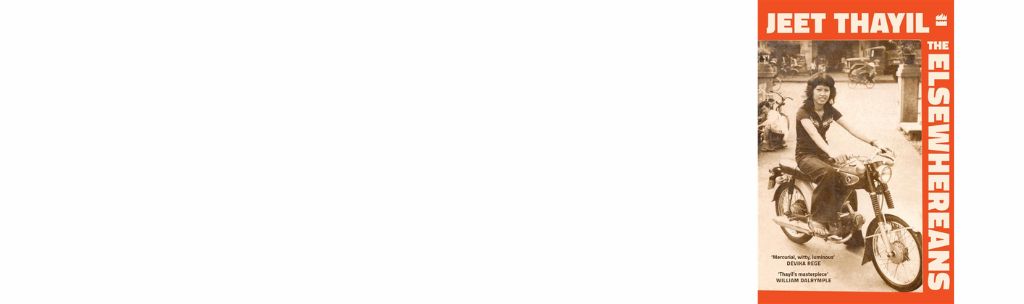
With The Elsewhereans, Thayil has succeeded in weaving what many of us fail or even wish to imagine — accounts of parents as people, before they were the former and how they continued to be people while being parents. It is a moving novel, a patchwork of stories remembered and heard over the course of the author’s life that come together to form an intimate epic. As we transition from the early days of postcolonial India to a Kerala combating the ravages of Hindutva in 2021, the cover image of Nguyen on a motorcycle, from 1973, begins to make sense. Just like she does not wish to be photographed in 2018 so George can continue to remember her as his young guide in Vietnam, so does this series of stories long to be left to the time and place they once occupied.
Shahim is a graduate of the Department of English at the University of Hyderabad and currently works in the Arts and Culture sector. He has an interest in cinema, photography and other visual mediums.
Header Image: HarperCollins Publishers India


