
Cite this Essay
MLA:
Mohanty, Megha Manjari. “A Portrait of the Writer as a Daughter: Arundhati Roy’s Mother Mary Comes to Me.” Indian Writing In English Online, 16 December 2025, https://indianwritinginenglish.uohyd.ac.in/a-portrait-of-the-writer-as-a-daughter-arundhati-roys-mother-mary-comes-to-me-megha-manjari-mohanty/ .
Chicago:
Mohanty, Megha Manjari. “A Portrait of the Writer as a Daughter: Arundhati Roy’s Mother Mary Comes to Me.” Indian Writing In English Online. December 16, 2025. https://indianwritinginenglish.uohyd.ac.in/a-portrait-of-the-writer-as-a-daughter-arundhati-roys-mother-mary-comes-to-me-megha-manjari-mohanty/ .
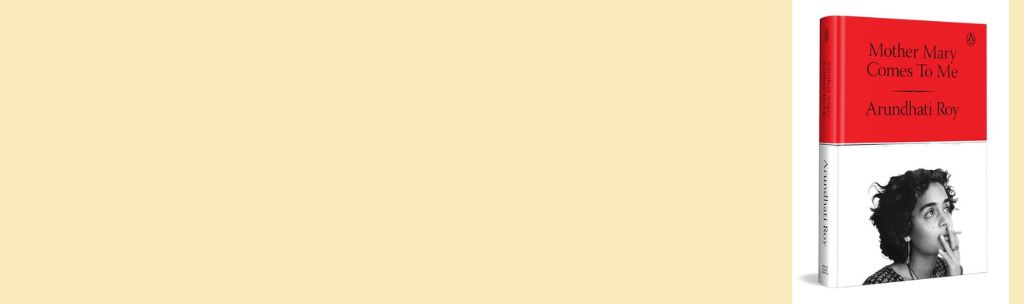
Review: Arundhati Roy. Mother Mary Comes to Me. Penguin, 2025
In 2011, G. Thomas Couser, looking at the widespread popularity and consequent rise in sales of memoirs, declared that we are living in “an age– if not the age– of memoir” (3). Over the past decade or so, the commercial and critical success of several memoirs, such as The Test of My Life (2013) by Yuvraj Singh, Sujatha Gidla’s Ants Among Elephants (2017) or Salman Rushdie’s Knife (2024), attest to the memoir’s rise to cultural prominence. Of the large number of memoirs that flood the market every year, a substantial share is made up by memoirs written by celebrities, or as Lorraine Adams (2001) famously terms it, the “somebody” memoir. The logic behind this is fairly simple– the more famous, or better yet, controversial, a person is in the public eye, the better the sales and easier the marketing will be.
Pramod Nayar (2017) notes that Arundhati Roy, in cutting across genre and domain, “has demonstrated a kind of celebrity that is rare in India” (2). This makes Roy an ideal candidate to author a memoir; her reputation as Booker-Prize winning writer as well as her activism and contentious polemic guarantees a ready readership. So when she did write a memoir, Mother Mary Comes to Me (2025), Penguin did not miss a beat in launching one of the largest marketing campaigns the publishing industry has seen in recent times. Beyond the usual autographed pre-ordered copies and merchandise and Roy’s appearance on The New York Times “The Interview” podcast, the book has an Instagram profile of its own, offering exclusive behind-the-scenes content, and is even available on quick commerce platforms like Blinkit. The memoir’s launch was no less than a cultural event that signaled the evolving future of the genre’s publicity in the “algorithmic new age”. Barely over a month into publication, Roy’s memoir has already stirred up controversy over the cover page featuring a picture of the author smoking, without any statutory warning. On the other end of the spectrum, however, it has met with glowing reviews by The Guardian and The New York Times, and the wave of personal reflections it has triggered, by daughters about their own relationships with their mothers, is a testament to the memoir’s reach and resonance.
Arundhati Roy began writing Mother Mary Comes to Me after the death of her mother, Mary Roy; a loss that left her “heart-smashed” (2). By way of an apologia or justification of her writing the memoir, she explains that she writes “to bridge the chasm between the legacy of love she left for those whose lives she touched, and the thorns she set down for me” (7). Mary Roy, on one hand, was a formidable woman who established the Pallikoodam school in Kottayam, Kerala and challenged the Travancore Christian Succession Act in the Supreme Court to secure equal inheritance rights for Syrian Christian women. On the other, she was an unapologetically exacting and volatile mother who inspired in her daughter a mix of admiration and resentment. Roy recalls episodes of humiliation and rage prompted by her mother’s relentless pursuit of perfection that often left both of her children feeling diminished, unloved and at times, physically and emotionally wounded. In a telling incident from her childhood, she recounts her mother punishing her brother almost malevolently in the middle of the night, beating him with a wooden ruler until it broke, for his poor grades at school while Roy secretly watched through the keyhole, filled with terror. The very next morning, when Mrs. Roy praised her for scoring exceptional grades, a young Arundhati was consumed by a sense of shame that she claims has shadowed her ever since. Roy writes, “Since then, for me, all personal achievement comes with a sense of foreboding. On the occasions when I am toasted or applauded, I always feel that someone else, someone quiet, is being beaten in the other room. If you pause to think about it, it’s true, someone is” (43).
Yet, Mary Roy is not a villain. Rather, Arundhati Roy shows her to be a woman shaped by her own history of the oppression and isolation that she faced at the hands of her violent Imperial Entomologist father, a husband who turned out to be a drunk, and the society at large, which chastised her for marrying outside the community, labelling her children “Address illathupillaru” or “the children without an address” to indicate that their parentage was dubious, making them socially illegitimate (317). Her harshness, Roy suggests, is an armour that she wore to survive a patriarchal society that punished independent thinking in women. The narration oscillates between pain, understanding and forgiveness showing how, ironically, love and violence coexist within the same intimate, originary relationship. Mary Roy’s rage becomes, in Roy’s narration, both the fire that inflicts her deepest wounds as well as the crucible that forged her fierce autonomy and shaped her into the writer that she is today. After all, Roy claims, “She was my shelter and my storm” (8).
What makes Roy’s memoir so compelling is her characteristic humour–witty and piercing, yet always self-aware and humane. She uses irony, witty observations and sardonic asides to cope with grief and also as a form of defiance to reclaim power over painful memories and expose the absurdity embedded in both domestic and social life because as Umberto Eco (1984) reminds us, “we can pass over in laughter the difficulty of living” (2). Her descriptions of her mother’s ferocity, the eccentricities of her friends and foes, hypocrisies of the media and the nation-state are laced with sharp yet mischievous humour that refuses victimhood. In one instance, she insists on putting down her mother’s name instead of her father’s on a government form, only to have it rejected by the person at the counter, who remarks “This is India, my dear” (159). She turns this statement on its head and uses it as a kind of refrain throughout the memoir, to comment on the normalized injustices and banal patriarchy of Indian society, most memorably when she talks about the church refusing her mother a burial in its cemetery for marrying an “outsider” and yet having no problems in allowing her uncle to rest there, despite him having married twice, the first time to a Swedish woman he had met at Oxford.
The memoir also serves as Roy’s creative self-portrait, tracing the origins of her novels and the evolution of her literary style and voice. It brings to life the real-world figures who inspired the characters in The God of Small Things (1997)— a handsome young man who befriended a six-year-old Roy and taught her to fish became the inspiration behind Velutha; Mary Roy’s brother, the Rhodes scholar, G. Isaac, inspired Chacko; her absent father Mickey Roy became Baba; while the Imperial Entomologist grandfather became Pappachi and the almost-concert-violinist grandmother became Mammachi. We also meet the Meenachil River, which became Roy’s muse and confidante, as she conceptualized the emotional landscape of the novel. Particularly poignant is her account of the real-life inspiration behind Pappachi’s moth– a cold, fluttering presence Roy imagined visiting her each time her mother made her feel inadequate, which went on to become the novel’s symbol of shame and sorrow. The memoir also traces how Roy developed her characteristic visual style of writing. She explains “I knew that if I could describe my river, if I could describe the rain, if I could describe feeling in a way that you could see it, smell it, touch it, then I would consider myself a writer.” (215). Roy talks too about how her early screenwriting experience shaped her desire to create what she calls a “stubbornly visual but unfilmable book” (215), adding a nuanced rationale to her oft-repeated refusal to allow The God of Small Things to be adapted for the screen, something she once described as her resisting the “novel to be colonized by one imagination”.
Mother Mary Comes to Me is, at once, an act of mourning and an act of making. What begins as an elegy for her mother soon expands into a journey where we see how Roy’s stories are born from pain, resistance and resilience. The memoir reminds us that her literary imagination and political voice spring from the same source– her ability to see beauty and absurdity, tenderness and cruelty as two sides of the same coin, coexisting in the same moment. As she oscillates between the two, she redefines what it means to write about care, loss and survival. In doing so, the memoir becomes not just a daughter’s reckoning, but a writer’s declaration of how language can hold both love and defiance.
Works Cited:
Adams, Lorraine. ‘Almost Famous’. Washington Monthly, 1 Apr. 2001, https://washingtonmonthly.com/2001/04/01/almost-famous/.
Couser, G. Thomas. Memoir: An Introduction. Oxford UP, 2011.
Eco, Umberto. ‘The Frames of Comic “Freedom”’. Carnival!, eds. Umberto Eco, V.V. Ivanov, Monica Rector. Mouton, 2011, pp. 1–9.
Gidla, Sujatha. Ants Among Elephants: An Untouchable Family and the Making of Modern India. Macmillan, 2017.
Nayar, Pramod K. ‘Mobility and Insurgent Celebrityhood: The Case of Arundhati Roy’. Open Cultural Studies, vol. 1, no. 1, Jan 2017, pp. 46–54.
Roy, Arundhati. Mother Mary Comes to Me. Penguin Random House India, 2025.
———. The God of Small Things. Indiaink ,1997.
Rushdie, Salman. Knife: Meditations after an Attempted Murder. Random House, 2024.
Singh, Yuvraj. The Test of My Life: From Cricket to Cancer and Back. Penguin Random House India, 2013.
Megha Manjari Mohanty is a Ph.D candidate in the Department of English at the University of Hyderabad. She also teaches English at Aska Science College, Odisha.
Header Image: Penguin Random House India


