
Cite this Essay
MLA:
Chandran, K. Narayana. “Kamala Das’s My Story at 50: Reflections.” Indian Writing In English Online, 28 September 2025, https://indianwritinginenglish.uohyd.ac.in/kamala-das-my-story-at-50-reflections-k-narayana-chandran/ .
Chicago:
Chandran, K. Narayana. “Kamala Das’s My Story at 50: Reflections.” Indian Writing In English Online. September 28, 2025. https://indianwritinginenglish.uohyd.ac.in/kamala-das-my-story-at-50-reflections-k-narayana-chandran/ .
KAMALA DAS’S MY STORY AT 50: REFLECTIONS
Madhavikutty who wrote Ente Katha was not Kamala Das who rewrote its English, My Story. The new name needed a voice and address different from the ones that began the telling. Only the Psalmist believes that we spend our lives as a tale that is told. Writers probably do not. They may not think they will be born again, but they hope for the afterlives of words. Life does not have words, but we do. The laws that we devise to tell lives are ours. We even amend them in order to explain our life we call experience― where we live, what we live for, as Thoreau puts it memorably. Those words, sometimes Malayalam, some other times English, live. Or so they must, as writers fancy.
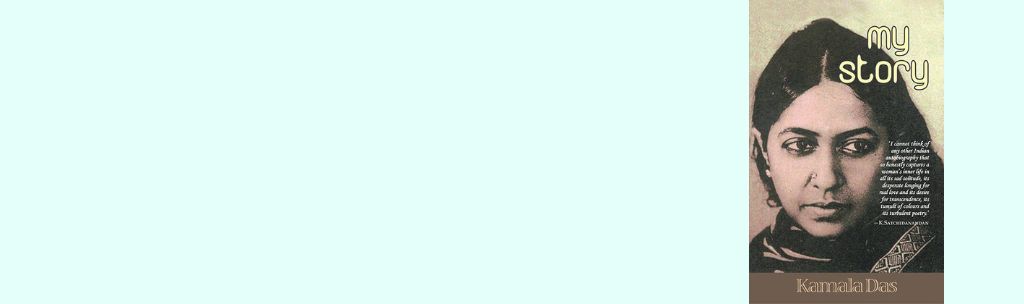
My Story was destined to run at least for 50 years, and was meant to read like an English family saga in parts, one written in anticipation of a literary-critical tradition whose infinite variety has certainly run its fairly decent course. The printings for successive generations find in Kamala Das’s story more and more traces of the straight, and not-so-straight, erotics whose names are legion. There is hardly any truth in it we could say is “self-evident” to hold it for long. A story for all seasons of critical thought, My Story now engages many readers as a bellwether that tells them what it means to study, not the book but its readers reading a Malayali woman who dares write her English story. (1)
Why this should happen to only Kamala Das among Indian writers, and why her story continues to be read today still puzzles me, but I often relish my story of first reading it serially. When the Malayālanādu pages of the early 1970s carried Madhavikutty’s weekly story, I was all of twenty. In retrospect, everything seemed new to me at the time, even the ordinary details and facts that fed informed readers and reading. I was a non-discriminating reader of all stuff that did not sting my eyes or tax my small brains. I was beginning to learn, unassisted by the ministrations of a syllabus, that the loneliness of the kind I made peace with was one of understanding but not being understood. With little conscious effort on my part, what needed lodging in my memory got lodged. For sure, I do not even recall my wondering why Ente Katha was either received with benign puzzlement or angrily rejected by some establishments. Pamman’s Vaṣaḷan was processed by my turbine with as much care or the lack of it as it did this story. Both Pamman’s man and Madhavikutty’s woman told roguish tales. With such tales, one tale leading to another, were the Malayali readers at the time really opening alternative portals to the good old picaresque? Perhaps. I dared not ask all this then, for want of appropriate critical idiom, but I seemed to sense in such writing a “something there is that doesn’t love a wall.” Or, such writing appealed to me, a little like an invitation to look over the walls where young people are apt to be doing something slightly unusual, shaded as they assure themselves from public view.
My Story retains for me that look of Ente Katha’s guilty shadow. I dare not adduce all my reasons for this feeling, but at least this. First of all, I do not have a digital footprint to follow the precincts my old reading. The Malayālanādu numbers are beyond my material reach today, their temporal aura underscored by supplementary data, the company Ente Katha had then kept (the 1970’s cover pages and contents, advertisements, trade notices, cartoon sketches, literary and political writing, cinema reviews, and the editorials …) largely missing even in a Malayalam reprinting of the original text. (2) But memory is such a shifty and shifting affair. We misremember the quanta and affects when our reading habits change. Second, when a writer changes the language of her story, she changes not just the fiction but its reading public to a certain unforeseeable length. So much so that the first readers who were privileged to see or read the story in both languages now forfeit that radical innocence vouchsafed only to the less privileged. I am sure what I am saying is not easy to appreciate unless someone hardier than most researchers undertakes to read the best Malayali critics of Ente Katha to see how different they sound in comparison with those who write in English on My Story. Perhaps a more scholarly and useful work would be to undertake a textual-genealogical exercise, beginning with some prefatory matter relating the book’s publishing history including its various modes and strata of reception, its multiple texts and reprintings, the layered editorial interventions that gave us newer palimpsests of Ente Katha / My Story through the last few decades. Unfortunately, that is not yet to be from what I see around my academic vicinity. Everyone wields a nondescript theoretical hammer. They can only see prurient nails to pick from My Story. Who could stop them?
_____________
Over the years, it has given me sheer fun to investigate how readers have seen My Story in ways that probably made it an object of study: in generic terms, as a feminist confessio amantis of sorts; in socio-historical light as a document of cultural realism; in a restrictive critical format as a sob story interspersed with lighter moments of self-discovery; in comparative crosslight, perhaps as a Malayali retelling of Judy Blume’s pop-classic Are You There God, It’s Me Margaret? (1970). Since My Story is and is not a “Me-Too” outrage, and in any case was not meant to be, some future reader will certainly look still for those Adela Quested moments in it― for that fantasy muddle that does not quite speak its name: who touched who, first ….
Be that as it may, I sometimes wonder what is it those readers’ clubs gain exactly by organizing a do at enormous cost to remind us of the 50 or 100 years of some book. Do they really want to ask whether this book or that juncture in literary history marked the birth of a classic? Or what signalled for us the obsolescence of which canon? Are they holding a memorial service for a still-born trend, mounting a hit-parade, commemorating a writer’s/ an event’s passing, or celebrating the triumph of some critical goodwill? What history has been made, or since then been unmade? (If, on an attributed merit being an “old” reader, I don’t willingly join such readers’ clubs, I might well be clubbed into admission, pretty much like the evidence on offer here.)
The point is that I am still not sure who declared My Story a classic― those who have been reading it still with much the same excitement as they had 50 years ago, or those who perfunctorily feel summoned to observe all publishing events and celebrate impressive print-runs to keep the research pot boiling in our departments of English India? There are, regrettably, more “my stories” to tell today than one would guess. In my department alone, I recall a virtual “My Story season” in the 1990s when nearly every M. Phil. student first thought of Kamala Das’s as a capstone text for their dissertations on any topic related to writing on or by women in India. A large body of such critical work begs not for further interpretive rumination but a far less glamorous task. A professionally neat bibliographical ledger or annotated survey is in order, pointing to the role of My Story in determining our business for those curricular calendars in our English halls. Did all that effort eventually let us notice that Kamala Das had not had, ever, the slightest regret of being a woman, but often had wondered why men (and the women who pleased them) did not even know what to make of a diminished woman thing to whom they nevertheless sang amorous paeans? In all seasons of love, therefore, such men make fools of themselves. Of course she was angry, very angry, at what was made of her gender. The exasperated spirit of Kamla Das gave up one faith for another just to see if there was any change in another theo-patriarchal matrix.
_____________
P. P. R. Talking of disguise I see that some of the poems are used as epigraphs to My Story. Does this imply any kind of continuity between the two?
K. D. My Story was written with a purpose, and was prompted by somebody very close to me.
P. P. R. Similarly, some of the poems seem to be reworkings of short stories originally written in Malayalam. Or is it the other way around?
K. D. There are so many complaints that I sell the same stuff as poetry, as story and as essay. […] I just dabble in all these areas, that is all.
(Raveendran 149)
To the first question here, Kamala Das is evasive. (Recall, Gertrude Stein’s last words to her death-bed attendant: What was the question?) P. P. Raveendran however does not hold her on to the point and insist. Evidently, she has neither misheard the question nor drawn a blank on the epigraphs but she would rather offer a roundabout explanation. PPR’s is a question about binding or bending genre, rather its lawlessness, in Kamala Das. Her answer asserts however a writer’s right to a generic laissez-faire. True, most readers have a subliminal insistence on a name for the piece of writing at hand. At least, on a fairly consistent style of emplotment to which they feel inured in time. For reading comfort, so to speak. And perhaps for sheer commercial purposes. When prose masquerades as verse, or sports a lyric mask before the prose begins; when the text before them misses a narrative beat or two, readers grumble. Complaints is probably ill-chosen, but Kamala Das might have noticed the discomfort of her readers who look for the missing novel in her shorter works, and stories that seemingly prolong her life, each shorter by turns as mere anecdotes or sketches. Probably she mildly resented PPR’s “disguise,” a true description nonetheless of her nomadic acts, just dabbl[ing] as she says among the conventional types and materials of storyworlds.
How many of us might have wondered why My Story gives us the impression of a young lady who just walked out on those tumultuous years of national Independence one day, and left an entire lifetime behind? That Kamala Das lived a segment of history is an illusion she creates in us, but certainly she cannot give us the impression that she herself was capable of being so disillusioned, then or later in life, about that illusion. She commanded the economic and circumstantial resources of the upper class to afford such a luxury of moving in and out of locales, across the whole continent, enjoying the comforts of a genreless jaunt. It amazes me to think that My Story is that rare book of episodic nomadism that answers to the now-fashionable narratives celebrated by someone like Pierre Joris. “A nomadic poetics,” writes Joris, “is a war machine, always on the move, always changing, moving through languages, cultures, terrains, times without stopping. Refueling halts are called poases; they last a night or a day, the time of a poem, & then move on” (26, Joris’s emphasis).
Look at those flash profiles in My Story: the Lizas, Mabels, Kunjis, Velus, Durgas, Unnimayammas, the Kunhappas and the Panickers. They exit as quickly as the cooks of the Nalapat House enter, falling in and out of feudal favour in Chapter 7. In a story driven by a breathless plot line, they are pretty much like Prufrock’s women who come and go― just names, but no character either in a moralistic or novelistic sense. And that, I believe, was the point Kamala Das wants us to accept. Her effigies are adrift on a narrative runnel, for the most part. Faceless, they remind us of their oddities. They are not persons with any distinctive voice, own language, a human idiom, to know them by. Even Carlo is more of a wall his lover chooses to bounce a lubricious ball off. Intermittently, without the slightest remorse:
‘You can marry me,’ said Carlo. ‘You can forget your grey-eyed friend, leave your indifferent husband and come with me to my country.’
‘We can probably have a love affair,’ I said, remembering the peace of my nights and the faces of my little sons closed in sleep. ‘I am not the divorcing kind…’ ‘And I am not Vronsky,’ said Carlo laughing. (My Story 115)
Frankly, I still cannot help laughing at this English probably (but what was its Malayalam, I forget) that modifies “can have.” But I am sure Carlo knows as much as we do that a fling is just that as they walk along the dirt road leading to the sea. “‘What is my future’ [Carlo] asked me. Have I a future at all?’” (My Story 117). Stooges know what they are for, in a plot. No tenses for them. Too bad, if they don’t see at least this much.
_____________
It is time we stopped worrying about My Story’s authenticity as an in-propria-persona book because I know of no writer’s published life that bares all the truth, and tells it straight. I love the word (and concept) Edith Wharton uses to call that character through whose sensibility a story is told: reflector. A reflector is one among the servants who lives the fiction of their maker, pace Count Axël’s “as for living” condescension in Villiers’s eponymous dramatic prose. No harm if some servants fare better in fiction than their betters.
For the sake of clarity, then, let us call the My Story-narrator a reflector. Let us add that it is easy for anyone to see Kamala Das’s admixture of genres if they take their minds off the unavoidable female or other sexualities in My Story. Rosemary M. George for one finds that generic mélange to be “queer,” perhaps viewing the reflector’s queer as physical and narrative, perhaps one involved crucially in affecting the other. George’s reading is exceptional in that it gives at least a straight look at “the slipperiness of [Kamala Das’s] writing” (741). That phrase refers to the “calculated unreliability as a narrator of autobiography,” which she believes “result[s] from a perennially unstable set of referential contexts [that] heightens the queer charge of autobiography” (741).
I regret however that George has stopped short of a bold exploration by not twinning gender-genre in advancing her queer thesis. In other words, before our simplistic academic insistence on writing styles, forms, and patterns of the kinds set in, no one in our hoary cultures ever bothered with genres when the mind processes language. All discursive traditions rightly know that raconteurs do not quite want us to tell the Dancer from the Dance. For they seldom use language the way we imagine they do. They often let language imagine language, and in so letting writers do what they are destined to write. Naturally, then, the strictly prosaic is never so much that, or only that. The lyric or the dramatic again is not as disciplined as it looks on our printed pages. Collapsing, combining, even complicating telling moods and teller-disposition, a story has only a for-the-nonce life, and is none the worse for it. Now think of our sexuality so called. Has it ever been curmudgeonly set to any stringent definitional remit, when we act sexually? And when someone goes the whole hog? Hardly. Like most of us, sex has a social life all its own whose signs are nuanced and known to be practised discreetly by the agents. Gore Vidal was once asked by a youngish interviewer about his first “sexual experience.” When he began, rather slowly to recall the event, the interviewer tagged on a bit, “With a man or a woman?” Vidal: I was too polite to ask.
I take it that the message of Kāmasūtra is to least bother about style sheets, mess with non-negotiable formats, when Kāma rules. (3) It is uncomplicated only when you read Kamala Das’s story as an autobiography tout court. It is “queer” if you see her point in telling those episodic loves slantingly. George has a short introductory article in Gender and History (2002) where, round and about, she extends the range of her “queer,” now suggesting that no figure, or the ground on which it stands, is fixed. That is, to say queer involves questioning the preset, if only to mean it fluid, or simply other. Drawing upon ancient eastern traditions of amorous thought, citing C. M. Naim’s authority on “Persian and Urdu literature,” George endorses Naim’s “[caution] against too easily inferring social reality and relations in any historical period through the lens provided by the literary texts from that period. He urges us to consider the pressures exerted by literary genres in shepherding meaning through specific ‘conventional’ routes” (10). The point is that hidebound queerism of the academy feeds generic slavery. It feels awkward when things involving love among the humans do not neatly click into place. Such queerist notions are still founded on highschool biology, despite the grown-up knowledge of the abundant light etymology casts on reproductive anatomy. And that knowledge treats gender and genre as scions. The gene makes for such guilt-free cohabitation.
_____________
In Art and Revolution (1969), John Berger observes that “The two great sensuous and imaginative distinctions― between life and death and between male and female― are neither nude nor enjoyed at skin level. It is necessary,” he adds, “to go further into the interior of the being until, ideally, we touch not the body but the experience of the body” (108, emphasis mine). It is a pity that most gender/ sexuality debates around fiction and the figures of life they engage do not even get round to this crucial detail, “the experience of the body.” My Story is not at any rate unaware of Berger’s distinctions but its tantalizingly short and occasionally fleeting records of the physical do not make for deeper thought. Maybe the serial cut of its Malayalam original played some role in diminishing such options for the writer. It may also be that Kamala Das couldn’t help being a vacuous poet of the soul rather than a sturdy chronicler of the body when passion calls. The following is perhaps not as perfect a sample as one would like to read, but it is handy enough to let us see how the reflector is in a hurry to catch her flight:
When I recovered from my serious illness I grew attractive once again. Then at the airport I collided with the elderly man who had once fascinated me just by turning back to glance darkly at me. I had heard of his fabulous lusts. He drew me to him as a serpent draws its dazed victim. I was his slave. That night I tossed about in my bed thinking of his dark limbs and of his eyes glazed with desire. Very soon we met and I fell into his arms. (My Story 174)
Back home, Amy dreams. The almost ethereal glow of her vision is owed to an abiding Krishna consciousness, one borne on the “inside of [her] eyelids, the dark god of girlhood dreams” (174). Charming for sure, yet low voltage.
Not an issue if Kamala Das wants to keep it that way, but we also hear some occasional griping, a resentment of sorts, that suggests that a woman of her distinction and privilege has often been baulked of pleasures that other, plainer, women seem to enjoy without any inhibition. (Perhaps Kamala Das is a forerunner of Arundhati Roys and Jhumpa Lahiris who celebrate such besetting “sins” of upper-middleclass Indian women.) The Nalapat traditions, social standing, and the cultural goodwill the reflector enjoys among her peers sometimes constitute an invisible law that she feels emboldened on occasions to transgress. Or, as I sometimes guess, is it the other way round? She ends up transgressing because the law throws up the challenge? Either way, the folkways require a law-breaker for them to exist in the first place. Carnal pleasure is that youthful body’s standing reproach to (and an old body’s grouse about) a class-code, the “right” conduct. Only its violation fulfils it. The vicious here is punningly a circle: the taboo depends for its force on the bold commitment of the vice it taboos. (4)
_____________
The truism that reading has changed rarely indicates how or why the young deal with old writing differently. Cases like My Story give us a reason to ask what has changed about its writing to which our young readers respond in a manner that surprises us. The tardiness of an event (among many others, the incident with which Chapter 22 opens), the slow unfolding of a scenario (such as the whole of Chapter 13), the dragging consequences or reactions on which the narrator dilates (“I tried adultery once” that begins Chapter 43 and ends with Krishna coming to her “in myriad shapes”) ― few young readers can put up with this tedium, attuned today as they are to instantaneous digital gratification. My Story belongs to a band of narratives that circulated serially in what economists call an age of “deferred gratification.” (The Kottayam town I grew up in during the first 20 years of my life advertised long-shelved and unsold goods and services ON SALE. What that meant for consumers then was that if they were willing to wait, the prices would fall and be affordable for the needy.) A reader of those years knew nothing of great consequence that awaits them in the serial story even if the suspense remained deferred for a couple of weeks. When the telling is slow, the teller trains the listener to be patient, a precept readers of the Book of Job learn to appreciate besides the devotional rigour it entails.
The uses of nostalgia however are another thing. Only that we are embarrassed while rummaging a curated past that the younger generations find quaint. Only other people’s longing offends. For my peers, My Story cannot help bring back memories of a world where we have often had interesting lives before the electronic/ cable revolutions. My own memory was both collection and storage in a simple brain which most of the time I effectively mined for information, knowledge, and that little bit of wisdom I had fought hard to value. My Story is certainly not one of the memorable things I would have loved to preserve from the old Malayālanādu pages, but I still miss other gems they had once held: an occasional poem or two, for instance, by M. Govindan whose short uḷpozhivukaḷ I regret not finding anywhere anymore, not least because I still am unsure what the word means, or what it had meant for the readers of that poem in the late ’seventies. Frankly, I do not regret that I missed any episode from My Story in the last 50 years, although I have sensed a sneaking interest I seem to have in what a newer study by students still made of it. By and large, I have found such critical work more suggestive of the minds of young readers than of any interesting idea that has been fully worked through. Few of them have escaped the sentimentalist or the moralistic trap set by their elders whose work the young readers seem to have assimilated.
What has sometimes struck me as rather odd is the circumambience of the Indian book world that invested My Story with a credible look and feel at which many Malayali writers of that generation would have marvelled. The publishing conditions that handpick items from a vast repertoire of excellent writing in the bhāṣās are no secret. There are valid reasons for the limited exposure of Indian regional cultures abroad, and not all of them have to do with discriminatory cultural intermediaries or the paucity of “good” translators. That granted, the smart set that gets their books marketed abroad from a hinterland looks at that success as compensation for having shared their lives, dared telling them with all the risks involved. Some deceit might always lurk behind or beneath the confession, but you cannot deny that those writers braved the confession, à la Saint Augustine, Rousseau. So, the initiative matters when the writer wills to be seen and heard across sensitive borders. Water finds its level, again, the way a writer finds her translator. And that writer has a bilingual grip, however tenuous, on the mechanisms of getting her words into print that more readers can access. If the writing is cinematic to boot, even potentially, that certainly helps. My Story will someday receive better attention to such trade privileges than it has.
_____________
At 50, what then shall we say about a piece of writing so widely applauded once as a fair sample of a modern autobiography in English India? That story is still refreshing in its refusal to capitulate to the Writing Workshop protocols such as they are understood in our country. Not written to a stringent genre-format either, My Story is easy to read, each of its chapters opening, sometimes with a teasing, mischievous hint of adventure, mystery, even romance: “A friend of my family warned me against associating with an eighteen-year-old girl residing in a college hostel, but when … I met her [I] felt instantly drawn towards her” (My Story 74). Love has always been in the air since then, and Chapter 20 that begins this way ends with some girlish fun “a dark corner behind the door” gives this person who lets us know that humans begin skin-deep love sometime before “An Arranged Marriage” of Chapter 21. And that “story” might be true, maybe she has just been telling it wrong.
Someday, some curious student is likely to see in My Story a handy case to speculate (just for polemical fun, perhaps) whether texts determine readers, or readers determine texts. In either case, the case here will not be settled for good because Kamla Das’s book appears to have enjoyed so much predetermined reception thanks to those who shepherded its publication, the first reviewers, publicity brokers, gossips, and the blurbists who habitually speak only fine things, the latter much in the vein of a polite admission that the book is readable but not quite a classic of its kind. In other words, My Story had told us so much about itself in the last five decades that we did not really have to read it again. The HarperCollins text I have used here calls it a “memoir … far ahead of its time and is now acknowledged as a bona fide masterpiece” (blurb, 2009).
One thing more. About Kamala Das and her English style. I am not sure that Madhavikutty’s non-education freed her into her own learning or was rather enclosed by it. In Malayalam, her chatty sparseness does not quite spoil the fun of reading her because the Malayali knows where those elliptical and oblique bits lead, mostly to moods that flipflop and settle like a pesky moth on a lighted wall. In English, an old highschool-grammar holds her hand, leaving her very little room for paratactical flourishes. In both Malayalam and English, probably a sly editorial hand might have worked. Of such things, we have no clue. (5)
_____________
Great books are monuments for the mind. However precarious, they endure because we teach them, urging our wards to read them. Especially, by attending to the experiential texture of what they are reading at the moment. We learn by what we reject as well as by what we accept. All that, I believe, is true but I cannot foresee a renewed interest in My Story, say, among the likes of the two or three latest post-Covid batches of Master’s students I taught who are averse to reading anything longer than a few dozen pages with genuine literacy or scholarly involvement. I do not sense a chorus of groans as I mention take-home reading of longish texts, but outside assigned reading and required writing, Kamala Das’s book is unlikely to be sought after by all students. Even by, I think, those enterprising ones who might be willing to read all Ruskin Bond for their term-papers on climate change or ecological disasters. It is no small mercy for the reader that My Story ends at that juncture where the elasticity of its writer’s mental processes slackens: “I have left colourful youth behind. … My heart resembles a cracked platter that can no more hold anything. … Perhaps I shall die soon” (213). Lives, it appears, are welcome when told of their short stretches. In any case, a tip-toed prolepsis Kamala Das calls the “reality” of death fills the last chapter of My Story. Too tragic, it does not quite tell us how to grieve in appropriate response. Unrelieved in its melancholy, this is rather tepid philosophy, mildly amusing fiction.
But all this is arguably beside the point. Who knows? I might still wager that Amy/ the reflector of My Story is that unusually intelligent woman who situates her self in the most difficult relationships to those who oppress her. Her disruptive potential to undermine normative negotiations between gendered creatures is not small. Although the craziest things in this book sound like those done for the sake of the memory of just having done them, it will be a pity if we do not recognize that her investment in, and dependence on, those very structures she rejects are heroic indeed.
Another way of saying all this is to concede that it is too early to treat My Story as a closed book. It will not that easily come up for sale in an intellectual flea market. After all, newer regimes of thought will find newer communities of learning. A new hunger for style, humour, and even frivolity will likely ask for food, cold-packed in storage. And such readers are likely to be tolerant towards a writer who gets the rich texture of human experience of whatever kind into view. If that happens, who can deny that My Story will, in time, court incisive readers? And some, indeed, will arrive before we recognize them.
NOTES
- I wish I knew that Madhavikutty’s story of her life was written first, from which emerged the much-later My Story. The dates of publication are apparently a mess. But that is another story. I am not a textual genealogist nor do I have the bibliographical means to crosscheck such details for accuracy. Conflicting accounts confront me wherever I look for information, but it seems almost certain that English has substantially coloured the scenes of nearly all the episodes even in the Malayalam story. Explanatory bits far outnumber regular unaffected telling in English, a sure sign that Kamala Das was aiming at a wide audience and large community of readers. (I thank Meena T. Pillai for answering my queries on the dates and publishing history of My Story. I am grateful again to P. P. Raveendran for answering my query on Madhavikutty’s formal education.)
- What has sometimes fascinated me to no end is the auratic look or feel of a piece of writing. What an article, poem or play, first looked in its first appearance on the pages of a magazine or broadsheet interests me because the site-specific appeal of art is often underestimated. That space is special and unique in that a writer of intangible goods and services rubs shoulders (only here) with rank commercialists and the crude business class. A site-sensitivity seems to inhere all writing, also because the first readers matter. A context in which a piece of writing/ art is received makes for our silent conversations with those curious items boxed adjacent to its discrete columns. The ad-space tells us what pained and what pleasured the reading public most during the period in which a story or poem was first published― balms for aches, emollients bandied as beauty products, analgesics and abortifacients, affordable housing options and fashionable clothing, pop entertainments, etc. Most anthologized and reprinted work is repurposed with trade motives of which newer readers are mostly unaware. I am still not sure that this is good or bad, but I am sure readers miss something when they remain unaware of the first public use of a literary object, unless they care the least for the ‘intentions’ of its maker.
- If we go beyond the graphics of the Kāmasūtra sketchbook, it will settle for us nearly all misgivings about the range of the “sexual,” besides alerting us to the literary genres and typological etiquette of social intercourse. It is a pity that most readers still find in it only the acts of physical love in “ancient India.” If one were to reflect on Vatsyayana’s klība alone, a book like My Story will begin to speak more to us about most men we meet on its pages. At least a newer reading of Kāmasūtra will open for us another door to dharma, a bid Kamala Das probably tries her best to make in all her writing. Put differently, the evenly quartered stages/ goals of Hindu spirituality are at least not to be seen as discretely mapped out and progressively outgrown by only men. A little kāma always inflects a self as it advances through arthā, dharma, and mōksha. No wonder, such wisdom is vouchsafed to insightful women.
- This, to my mind, compares with Sigmund Freud’s “Some Character-types Met with in Psycho-analytic Work” where he writes: “Paradoxical as it may sound, I must maintain that the sense of guilt was present before the misdeed, that it did not arise from it, but conversely― the misdeed arose from the guilt” (332).
- It may be small, but a detail hard to ignore: like most writers of English India, Madhavikutty never sat in an Eng. Lit. class to read the classics and the canon. She has never been to college, hardly ever qualified herself, in a way, to write the language of her life. Have her writing choices been served by being so unwaveringly stubborn and precociously independent? An open question.
WORKS CITED
Berger, John. Art and Revolution. Vintage, 1969.
Das, Kamala. My Story. 1988. Harper Collins, 2009.
Freud, Sigmund. “Some Character-types Met with in Psycho-analytic Work.” 1916. Selected Essays, vol. 14, pp. 309-33.
George, Rosemary M. “Calling Kamala Das Queer: Rereading My Story.” Feminist Studies, vol. 26, no. 3, 2000, pp. 731-63.
—, et al. “Introduction: Tracking ‘Same-sex Love’ from Antiquity to the Present in South Asia.” Gender & History, vol. 14, no. 1, 2002, pp. 7- 11.
Joris, Pierre. A Nomad Poetics: Essays. Wesleyan UP, 2003.
Raveendran, P. P. “Of Masks and Memories: An Interview with Kamala Das.” Indian Literature, vol. 36, no. 3, 1993, pp. 144-61.
Header Image: HarperCollins Publishers India


